The seven assets
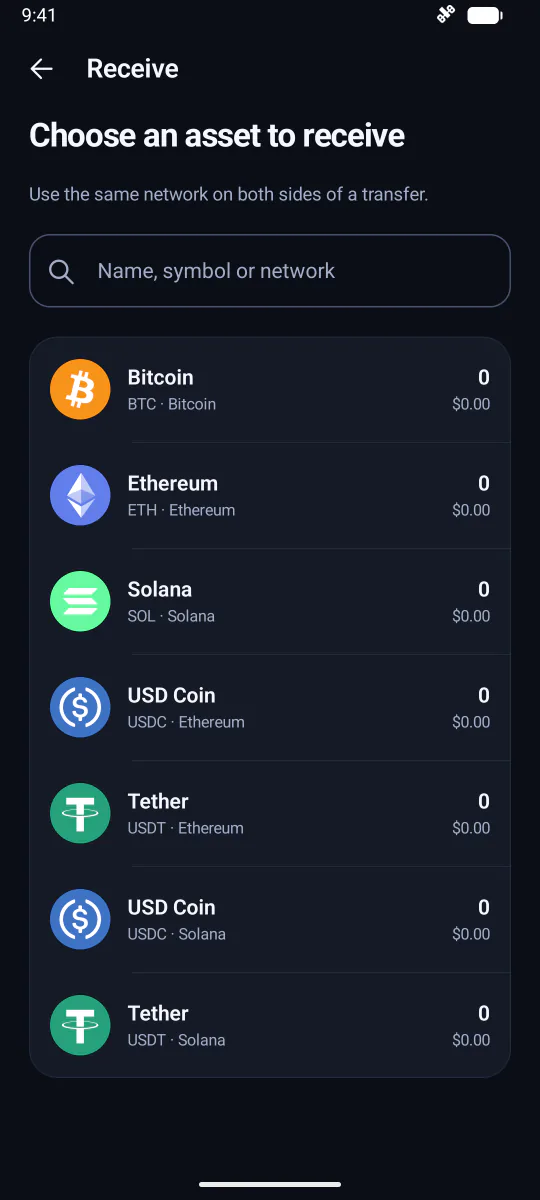
The same symbol on two networks counts as two assets. USDC on Ethereum and USDC on Solana are separate entries with different addresses, because on-chain they are separate tokens. Tokens on the same network may share an account address: ETH, USDC and USDT on Ethereum use one Ethereum address, and the Receive screen names the asset and network every time.
| Asset | Network | Standard | Fees paid in |
|---|---|---|---|
 BitcoinBTC |
Bitcoin | Native coin | BTC |
 EtherETH |
Ethereum | Native coin | ETH |
 SolanaSOL |
Solana | Native coin | SOL |
 USD CoinUSDC |
Ethereum | ERC-20 token | ETH |
 TetherUSDT |
Ethereum | ERC-20 token | ETH |
| USD CoinUSDC |
Solana | SPL token | SOL |
| TetherUSDT |
Solana | SPL token | SOL |
Bitcoin
BTC is the native coin of the Bitcoin network and the asset this wallet was originally built for. Bitcoin transactions pay a fee to miners that depends on the transaction’s size in bytes and how busy the network is. You review the fee before approving; our network fees guide explains how it is calculated.
On Android, the app synchronises directly with Bitcoin peers to learn about your balance and to broadcast payments. Your Bitcoin history in the Activity tab is built from that sync.
Ethereum
ETH is the native coin of Ethereum. USDC and USDT on Ethereum are ERC-20 tokens: smart-contract balances that live on the Ethereum network and move in Ethereum transactions.
- Every Ethereum transaction, including a stablecoin transfer, pays its fee in ETH. A wallet holding only USDC cannot send it until it also holds a little ETH.
- Before you approve, the app shows a maximum network fee. The amount actually charged can be lower, never higher.
- Balances and transaction broadcasts go through an Ethereum RPC provider. Activity shows the Ethereum payments this installation sent.
Solana
SOL is the native coin of Solana. USDC and USDT on Solana are SPL tokens. They are not interchangeable with their Ethereum counterparts, and a Solana address is never a valid destination for an Ethereum token.
- Solana fees are paid in SOL, including for USDC and USDT transfers.
- The first time a recipient receives a particular token, the network may require a token account to be created for them. When that applies, the app shows this cost separately on the review screen.
- Balances and broadcasts go through a Solana RPC provider. Activity shows the Solana payments this installation sent.
Why the network matters
Addresses only mean something on their own network. A transfer sent to the right-looking address on the wrong network can be permanently lost, and no wallet, exchange or support team can reverse it.
SatKeep reduces that risk in three ways:
- The Receive screen names the network under every address and asks senders to use the same network on both sides.
- The Send flow states which network it is sending on and shows it again on the review screen.
- Assets with the same symbol are listed as separate entries with their network in the subtitle, never merged into one balance.
Fees and native coins
Each network charges fees in its own coin. That means a stablecoin balance alone is not enough to move a stablecoin.
- BitcoinFee paid in BTC, based on the transaction size and the fee rate you review.
- EthereumFee paid in ETH for ETH, USDC and USDT transfers. The review screen shows a maximum fee.
- SolanaFee paid in SOL for SOL, USDC and USDT transfers, plus token-account creation when the network requires it.
Fees go to the network’s miners or validators, never to Rowix or SatKeep. The app adds no fee of its own.
US-dollar estimates
The portfolio total and the per-asset values are estimates. The app requests public exchange rates from Coinbase and does the arithmetic on your phone; the request carries no wallet addresses, balances or history. Estimates can differ from the price you would actually get elsewhere, and a stablecoin’s estimate is not a guarantee that it is worth exactly one dollar.
Not supported
Being clear about what is missing is part of being a wallet you can rely on. SatKeep does not offer:
- Other tokens or networks. USDT on Tron, assets on BNB Smart Chain, Polygon, Arbitrum, Base or any other chain are not supported, and sending to this wallet on those networks will not work.
- The Lightning Network.
- Buying or selling with fiat currency, swaps between assets, or staking.
- A dApp browser or wallet-connect style connections to third-party applications.
If a feature matters to you, tell us at support. We would rather hear it than guess.
Older Android versions
Android versions 1.0.x support Bitcoin only. Updating to 1.1.0 keeps the same package, the same Bitcoin wallet and the same backup format; it does not replace your Bitcoin keys or move your funds. For compatible wallets it derives Ethereum and Solana accounts from the seed you already have. Keep a verified encrypted backup before updating or changing devices, as you would before any change to a wallet.